Answer Snapshot:
Plan frozen banana pop orders from the current case specifications, measured freezer space, expected weekly sales, delivery lead time, and safety stock. Convert unit demand into full cases, leave room for airflow and access, and set a reorder point before launch. Never rely on an old case count or estimated box size when the supplier can provide a current spec sheet.
Key Takeaways
- Use the current outer case dimensions, weight, units per case, and storage instructions from the supplier.
- Measure usable freezer space, not only the appliance size; shelves, baskets, doors, airflow, and access reduce capacity.
- Convert forecast unit sales into full cases and round up only after adding the chosen safety stock.
- Set a reorder point from average demand during lead time plus safety stock, then review it after the first sales cycle.
- Track date codes and rotate stock so the oldest acceptable product is sold first.
Case-pack planning connects purchasing to daily operations. If the case is larger than expected, it may not fit the assigned shelf. Otherwise, if the starting order is too small, the venue may sell out before the next delivery. If it is too large, cash and freezer space sit in slow-moving inventory.
A simple worksheet solves most of this problem. You need the supplier case details, a realistic sales range, the time between ordering and receiving, and a small safety-stock rule that matches the business.
Plan from Case Dimensions and Sell-Through, Not Guesswork
Begin with two separate questions: “How many cases can we store?” and “How many cases should we buy?” Freezer capacity answers the first. Expected sell-through and replenishment timing answer the second. The lower result is usually the practical starting limit unless the operation adds storage or changes the delivery schedule.
Totally Bananas currently lists its foodservice cases as 24 individually wrapped units of one flavor, with an approximate weight of 7.5 pounds and approximate dimensions of 10 x 12 x 6 inches. These details are useful for an example, but buyers should confirm the current case specifications before every order or distribution decision.
Case-Pack Terms Buyers Need to Know
| Term | Simple meaning | Planning use |
| Sellable unit | One wrapped item offered to the guest | Used for sales forecasts and price-per-unit calculations |
| Units per case | Number of sellable units packed in one outer case | Converts unit demand into order quantity |
| Single-SKU case | A case containing one product or flavor | Affects flavor balance and minimum inventory |
| Case dimensions | Outside length, width, and height of the shipping case | Tests shelf fit and estimated cubic volume |
| Case weight | Approximate weight of a full case | Supports receiving, handling, shelving, and freight planning |
| Shelf life | Supplier-stated period under required storage conditions | Supports buying limits and stock rotation |
| Lead time | Time from accepted order to expected receipt | Drives the reorder point |
| Safety stock | Extra inventory held for demand or delivery variation | Reduces stockout risk but uses cash and space |
Measure Freezer Capacity and Receiving Space
- Choose the exact freezer, shelf, basket, or back-stock area assigned to the product.
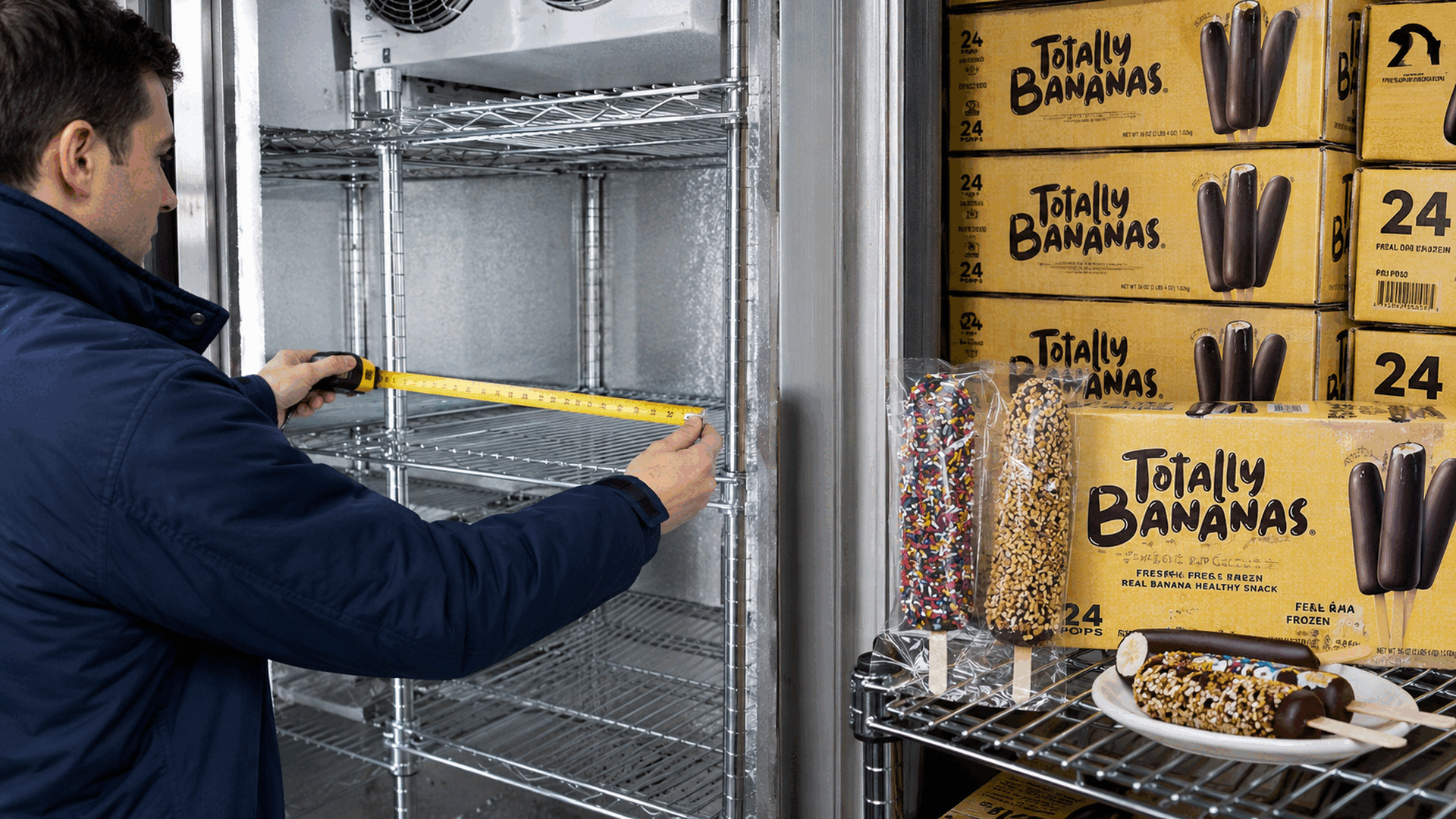
- Measure clear internal width, depth, and height after shelves and hardware are in place.
- Check the door path and the space staff need to reach, count, and rotate cases.
- Leave the airflow space required by the freezer manufacturer and your operating procedures. Do not pack the cabinet so tightly that cold air cannot circulate.
- Test the physical case orientation. A box may fit by volume but fail to fit through the door or between shelf supports.
- Reserve room for open cases, display stock, other products, and short demand peaks.
Outer case volume is only a first estimate. Multiply length x width x height, then divide cubic inches by 1,728 to estimate cubic feet. A 10 x 12 x 6 inch case has a box volume of about 0.42 cubic feet. The freezer will hold fewer cases than a simple total-volume calculation suggests because real storage includes shelves, gaps, uneven shapes, and access space.
FDA storage guidance advises keeping a freezer at 0 F (-18 C) and avoiding over-crowding that prevents air circulation. The supplier label and your own food-safety procedures should control the exact handling of the product.
Estimate the Starting Order and Reorder Point
Step 1: Forecast weekly unit sales
Use comparable products, guest counts, operating days, and seasonality. Create low, normal, and high estimates. A new product forecast is uncertain, so a range is more useful than one exact number.
Step 2: Cover the time until the next delivery
Multiply expected weekly unit sales by the number of weeks the order must cover. Include the supplier lead time, your internal approval time, order cutoff, receiving schedule, and any days when the venue cannot accept delivery.
Step 3: Add safety stock
Choose a clear rule, such as one extra case or a set number of peak sales days. Safety stock should reflect demand and delivery variation, not fear. More safety stock can reduce stockouts, but it also takes freezer space and increases slow-inventory risk.
Step 4: Convert units to full cases
Use this formula: starting cases = round up [(forecast units for the coverage period + safety stock units) / units per case]. If the result does not fit the freezer, reduce the coverage period, change the delivery pattern, reduce flavor count, or add approved capacity.
Step 5: Set the reorder point
Use this formula: reorder point in units = average demand during the lead time (the time until the next delivery) + safety stock. Convert that number to cases or use individual-unit inventory if the operation counts open cases accurately.
Confirm Storage, Shelf Life, and Rotation Requirements
- Required storage temperature and any instructions for receiving or temporary staging.
- Supplier-stated frozen shelf life and how it is measured from production, packing, or another date.
- Location and meaning of lot, production, best-by, or other date codes.
- Process for documenting and reporting damaged, thawed, open, or unreadable cases.
- Whether open cases may remain in the same storage area and how individual units should be protected.
- Rotation method and the staff role responsible for weekly inventory checks.
Use first-expired, first-out when the date codes support it. Keep older acceptable stock visible and accessible, and do not hide partial cases behind new deliveries. A short weekly count can catch slow flavors, damaged wrappers, and an incorrect reorder setting early.
Case-Pack Worksheet Example
The example below uses the 24-unit case listed on the current Totally Bananas foodservice specification page. It is planning math, not a recommended order quantity.
| Worksheet input | Example | Calculation or decision |
| Units per case | 24 units | Confirm on the current supplier spec sheet |
| Expected weekly sales | 36 units | Use a normal forecast after reviewing low and high cases |
| Coverage period | 2 weeks | Time from placing an order until the next delivery |
| Safety stock | 24 units | One extra case in this example |
| Required units | 96 units | (36 x 2) + 24 |
| Starting order | 4 cases | 96 / 24 = 4 full cases |
| Approximate case volume | 0.42 cu. ft. | 10 x 12 x 6 / 1,728 |
| Approximate box volume for order | 1.67 cu. ft. | 0.42 x 4; add operating space for airflow and access |
| Reorder point with 2-week lead time | 96 units or 4 cases | (36 x 2) + 24; adjust after actual sales data |
If actual sales rise to 48 units per week, the same two-week lead time and one-case safety stock would produce a 120-unit reorder point, or five cases. If sales fall, reduce the forecast and review whether a smaller flavor range would improve rotation.
Frequently Asked Questions
What does a 24-count case mean?
It normally means that the outer case contains 24 sellable units. Confirm whether all units are the same SKU and whether the supplier sells only full cases.
How much freezer space does one case need?
Use the current outer case dimensions and test the real shelf. Cubic volume is only an estimate because doors, shelves, airflow, access, open cases, and other products reduce usable capacity.
How many cases should a new venue order?
There is no universal number. Use forecast sales for the coverage period, add defined safety stock, divide by current units per case, round up, and confirm that the result fits both freezer and budget.
What is a good reorder point?
A practical reorder point covers expected demand during the full lead time plus safety stock. Review the result after launch and adjust for actual sales, stockouts, seasonality, and delivery performance.
Can different flavors be mixed in one case?
Not always. The current Totally Bananas foodservice page states that each case contains one flavor. Ask the supplier whether mixed cases or distributor-specific programs are available in your market.
Confirm Current Case Details with Totally Bananas
Before setting freezer capacity or issuing a purchase order, review the current foodservice case specifications and contact Totally Bananas to confirm product availability, case configuration, dimensions, weight, storage guidance, shelf life, lead time, and ordering requirements.
Ask Totally Bananas for the current case specification sheet and ordering details before finalizing freezer capacity or order quantities.