Answer Snapshot:
Before buying frozen banana pops wholesale, confirm the exact product code (SKU), sellable units per case, case dimensions, storage requirements, shelf life, order minimums, lead times, delivery method, product documents, and issue-resolution process. A clear request for quote makes suppliers easier to compare and helps prevent freezer, receiving, and cash-flow problems after launch.
Key Takeaways
- Define the sales channel, expected demand, freezer limits, delivery location, and launch date before requesting a quote.
- Compare price per sellable unit as well as price per case, and include freight, fees, damage terms, and minimum-order rules.
- Request current product, label, allergen, nutrition, case-pack, storage, shelf-life, and certification documents for the exact SKU.
- Confirm what happens if a shipment arrives late, damaged, short, incorrect, or outside the agreed temperature condition.
- Use a small, measurable launch when possible, then set a reorder point from real weekly sales and supplier lead time.
Wholesale buying is more than finding a product and asking for a price. A buyer must know whether the case fits the freezer, whether deliveries fit the receiving schedule, whether the label supports the venue, and whether the supplier can provide the documents the business requires.
The best first order starts with a short operating brief and a consistent set of supplier questions. This keeps the conversation practical and reduces the risk of comparing quotes that include different products, pack sizes, delivery terms, or levels of support.
What Wholesale Buyers Should Confirm First
Start with product identity. Ask for the full product name, flavor, item number, UPC, package format, units per case, and whether each case contains one flavor or a mix. Two quotes can look similar while covering different portions or case counts.
Next, confirm the commercial path. Is the order placed directly with the manufacturer, through a broker, or through a distributor? Which party sends the invoice, arranges freight, manages shortages, and handles product questions? A clear path saves time when an order changes or a delivery problem occurs.
Finally, ask which information is firm and which is only an estimate. Price, minimum order quantity, lead time, freight, availability, and production schedules can change. Put the quote date and validity period in writing.
Define Your Channel, Demand, and Freezer Constraints
Sales channel and guest
Describe where the product will be sold: concession stand, attraction, convenience store, hotel market, grocery freezer, event venue, or another channel. Include the normal guest, target selling price, peak periods, and whether the item must scan through a point-of-sale system.
Demand range
Use a range instead of one confident number. Estimate slow, normal, and peak weekly sales. Note whether demand is seasonal, event-based, or steady. This helps the supplier suggest an order pattern without treating an early forecast as guaranteed demand.
Freezer and receiving limits
Record the usable freezer width, depth, height, shelf layout, and number of cases that can be stored without blocking airflow or access. Also note delivery hours, loading access, appointment rules, pallet limits, and who can inspect frozen goods when they arrive.
Wholesale Supplier Checklist
| Topic | Questions to ask | Record in the quote |
| Product | Exact product code (SKU), flavor, portion, wrapper, UPC, and sellable units per case? | Item number and current product sheet |
| Order terms | Minimum order quantity (MOQ) by product code or total order? Full cases only? Quote expiration? | Minimums, price basis, and validity date |
| Case and storage | Outer dimensions, weight, storage temperature, shelf life, date code? | Current case specification and storage statement |
| Timing | Normal lead time, order cutoff, production constraints, and peak-season changes? | Estimated ship and delivery windows |
| Delivery | Direct, distributor, parcel, LTL, or other method? Who pays freight? | Freight terms, delivery address, and any extra delivery fees |
| Documents | Ingredients, nutrition, allergens, facility statement, certifications, insurance? | Document names, versions, and renewal dates |
| Problems | Process for shorts, damage, thawing, late delivery, or wrong item? | Inspection window, contact, credit or replacement terms |
| Support | Samples, images, product training, menu copy, signs, or sales aids? | Included and optional support |
Product Quality and Label-Review Questions
Ask for the current label or clear package images before approving a product. FDA food labeling guidance covers required areas such as the name of the food, net quantity, ingredient list, nutrition information, and allergen labeling. Your organization may also require specific claims, certificates, insurance, vendor forms, or internal review.
- Does the sample match the product sheet and the package that will be shipped?
- Is the ingredient list current, and are major allergens and facility statements easy to find?
- Are dietary or certification claims tied to the exact SKU and supported by current documents?
- Is the wrapper sealed, readable, easy to open, and strong enough for normal freezer handling?
- Is the product size and coating consistent enough for the planned guest experience and price?
- Are lot or date codes readable, and can the supplier explain how to use them for rotation and issue reporting?
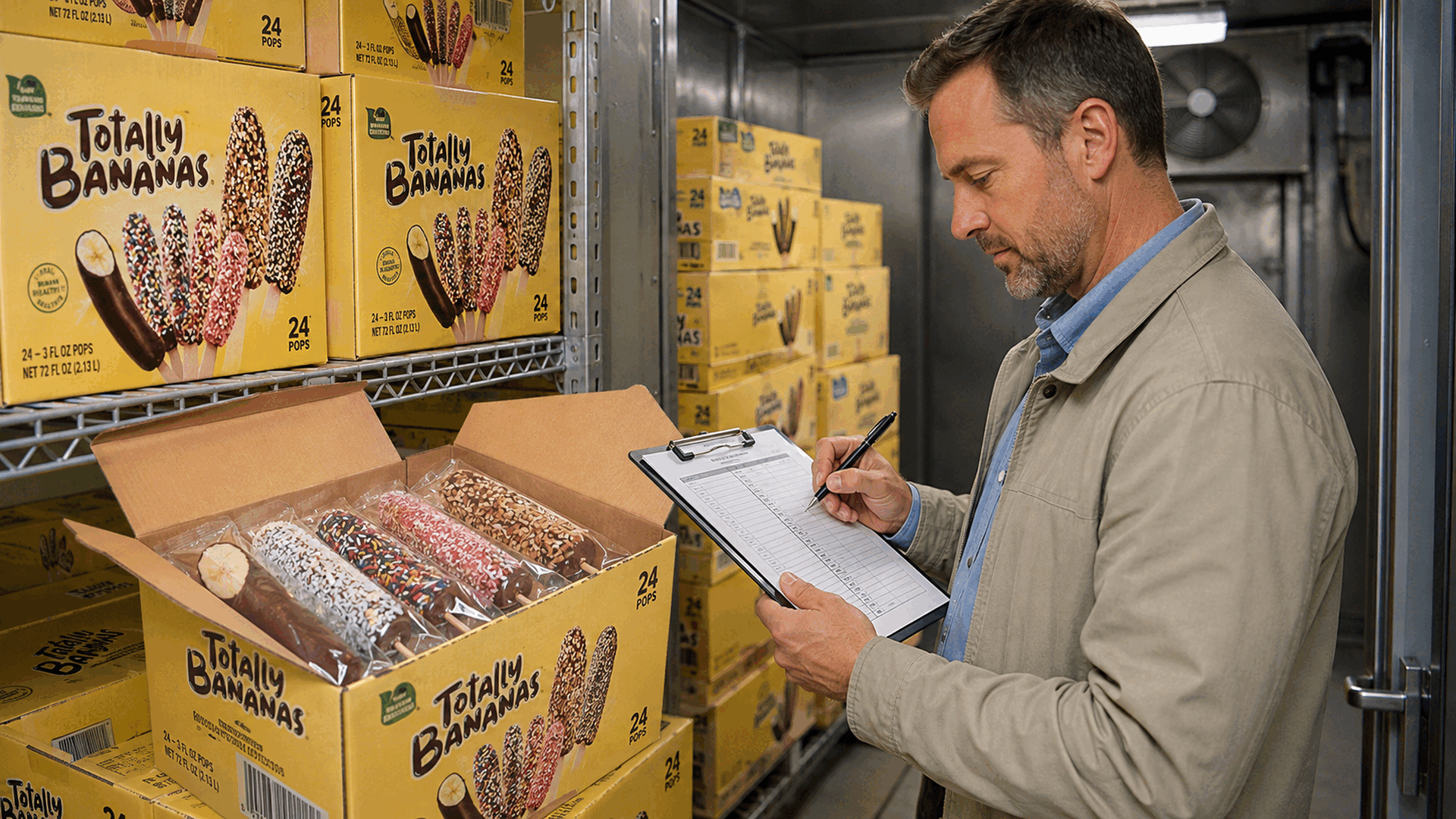
Totally Bananas publishes current ingredients, a facility statement, and foodservice case details on its Ingredients & Specs page. Wholesale buyers should still request the latest documents and review the exact package before ordering.
Receiving, Storage, and Reorder Checklist
- Prepare freezer space before delivery and confirm that the unit can maintain the required temperature.
- Give receiving staff the purchase order, expected SKU and case count, inspection steps, and supplier contact.
- Check case condition, product identity, quantity, date or lot codes, and any agreed temperature evidence before signing.
- Move accepted frozen product to storage promptly. Follow the package and supplier instructions; FDA consumer guidance uses 0 F (-18 C) as the freezer benchmark.
- Rotate stock by the supplier date-code method and keep older acceptable inventory easy to reach.
- Track weekly sales, stockouts, waste, damage, and the time from order to receipt.
- Set the reorder point high enough to cover normal lead time plus a defined safety stock, while avoiding more inventory than the freezer and sales rate can support.
If a delivery arrives in an unexpected condition, separate the affected product, document the case labels and condition, and contact the supplier according to the agreed process. Do not guess whether a temperature-abused product is acceptable for sale.
Simple Request-for-Quote Template
Use the fields below in an email or purchasing form. Keep the same structure for each supplier.
- Business name, business type, delivery city and state, and buyer contact information.
- Products or flavors of interest and whether samples are needed before approval.
- Expected launch date plus slow, normal, and peak weekly unit estimates.
- Available freezer space and any case-size limit.
- Requested price per case and per sellable unit, minimum order quantity (MOQ), lead time, freight terms, delivery method, and quote validity period.
- Requested product, ingredient, nutrition, allergen, facility, case-pack, storage, shelf-life, certification, and insurance documents.
- Requested policy for shorts, damage, thawing, incorrect items, credits, replacements, and recalls.
- Available samples, product images, staff information, signage, or merchandising support.
Finish with one direct question: “What important order, storage, or delivery requirement have we not covered?” This gives the supplier space to identify a constraint before it becomes a problem.
Frequently Asked Questions
What is a wholesale case pack?
A case pack describes how sellable units are grouped in one shipping case. Confirm units per case, whether flavors are mixed or single-SKU, outer dimensions, case weight, and the item number used for ordering.
Is the minimum order always measured in cases?
No. A supplier may set a minimum by case, SKU, total units, pallet, order value, delivery route, or distributor program. Ask how the minimum is calculated and whether it changes by market or season.
Should buyers ask for samples before ordering?
Yes when practical. A sample helps the team review product quality, portion, wrapper, label, scanning, storage, service speed, and menu fit. Make sure the sample represents the exact SKU being quoted.
How do buyers compare two wholesale quotes?
Normalize both quotes to price per sellable unit, then add freight, fees, minimums, case storage, expected waste, payment terms, documents, and supplier support. Record differences instead of assuming the lower case price is the better offer.
What information should be confirmed again before every launch?
Reconfirm current SKU availability, case pack, storage and shelf-life guidance, price, minimums, lead time, freight, labels, allergen information, certifications, and the problem-resolution contact.
Start a Wholesale Conversation with Totally Bananas
Buyers can review Totally Bananas foodservice frozen banana novelties and then use the contact form to share their business type, location, product questions, and order needs. The sales team can confirm current availability, commercial terms, and supporting documents for the market.
Contact Totally Bananas with your business type, location, expected volume, freezer limits, and requested product information.